
Criminal Court Cases in Davidson County
General Sessions Criminal Court handles initial appearances, misdemeanor matters within its jurisdiction, felony preliminary hearings, and criminal traffic work. When a felony is bound over and the grand jury returns an indictment, the case proceeds in a Davidson County Criminal Court of the Twentieth Judicial District. The Criminal Court Clerk maintains the public data for both levels. That shared clerk system helps a reader follow one matter from its early General Sessions events into State Trial Court without mistaking the change in venue for a second arrest.
The main clerk counter is in Suite 2120 of the Justice A.A. Birch Building, 408 Second Avenue North, Nashville, Tennessee 37201. The office can be reached at 615-862-5601. Daily criminal dockets are also posted through the General Sessions criminal case page. Goodlettsville Municipal Court separately handles city ordinance and traffic citations within its jurisdiction, while appeals from Tennessee criminal trial courts go to the Tennessee Court of Criminal Appeals.
Davidson County Case Search Coverage
The free Davidson Public Case Search combines two record eras. CJIS data covers General Sessions dispositions from January 11, 2000, and State Trial Court dispositions from July 11, 2000. Legacy Data reaches from 1980 to those separate start dates. The categories matter because the same name may appear in more than one part of the system, and the type of court determines which coverage date applies.
The clerk's search page shows the scope notice before a user relies on a result. This official Criminal Court Clerk source provides the context for the interface shown below.
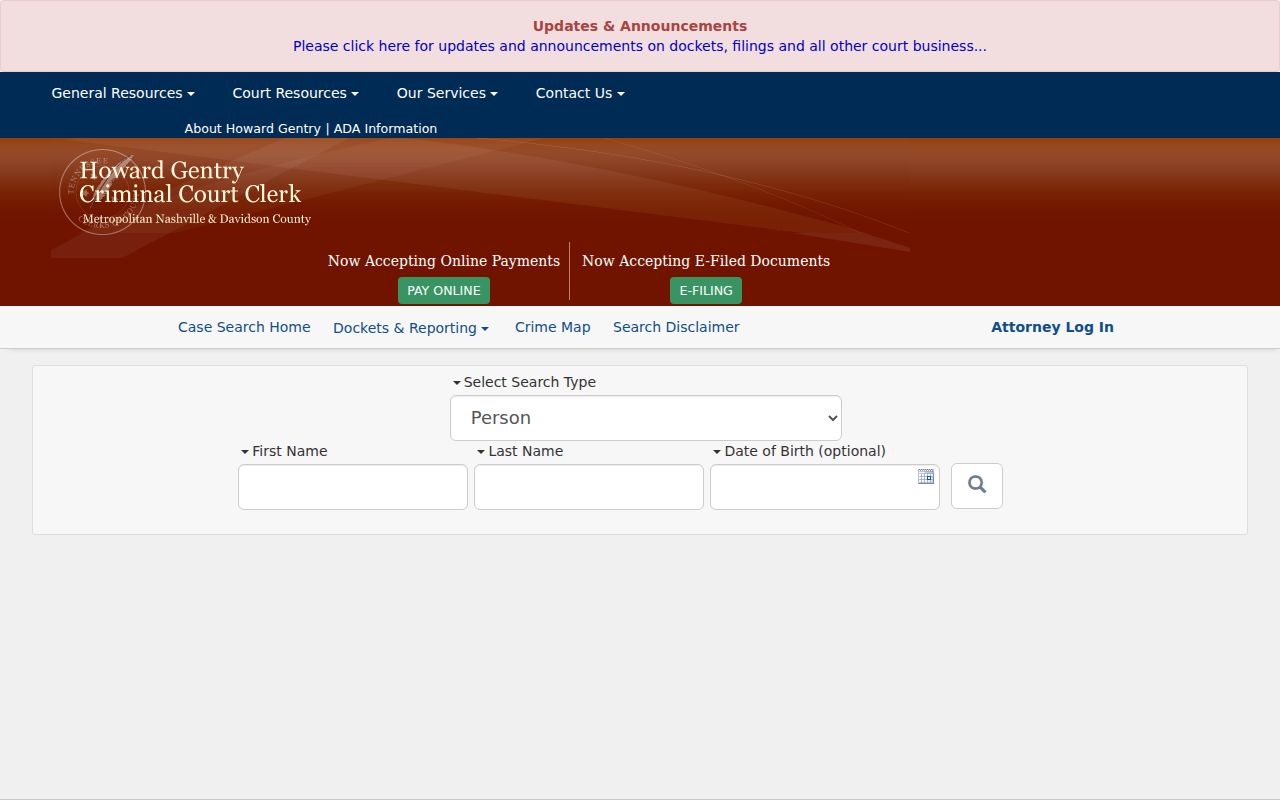
The image reinforces a key limit: a public index is a starting point, while the clerk is the source for verification and official copies.
Davidson County Case Record Searches
Use the name as it was entered by the booking agency. A date of birth is optional, but it can separate people with the same or similar names. If the result omits a date of birth, the clerk recommends verifying the defendant in person rather than assuming a match. A docket number is the best key for later requests because it ties the result to one court file.
- Open the Davidson Public Case Search and choose the name or case-oriented search type that fits the information available.
- Enter the first and last name with the booking spelling, or use the known case number.
- Add the date of birth when known to reduce false matches.
- Read the court, charge, docket events, and disposition together. Do not treat a pending allegation as a result.
- Contact the clerk for certified documents, missing pleadings, uncertain identity, or any record outside the online coverage period.
The interface uses a compact set of controls, but each one affects the reliability of a Davidson County criminal case search.
| Field Label | Type | Required | Notes |
|---|---|---|---|
| Select Search Type | Dropdown | Yes | Name or case-oriented choices; options may change |
| First Name | Text | Conditional | Use the spelling entered by the booking agency |
| Last Name | Text | Conditional | Use the spelling entered at arrest |
| Date of Birth | Date or text | No | Helps distinguish common names |
| Search | Button | No | Runs the selected query |
Note: Mobile access is available, but the clerk counter remains the fallback when identity or record age creates doubt.
Pre-1980 Davidson Criminal Cases
A missing online result does not prove that no Davidson County criminal court case exists. The public index's legacy coverage begins in 1980. For an older file, call or visit the Criminal Court Clerk and provide the defendant's known name, the approximate year, the court, and any docket number. The clerk also handles requests for pleadings that the public index does not make downloadable.
The DCSO inmate and public records page illustrates the separate jail-record channel shown below.

That split prevents a common local mistake. DCSO can supply inmate admission and release facts, but the Criminal Court Clerk supplies the filed case and certified disposition.
What a Criminal Case File Contains
A Davidson County case file records what happened after an allegation reached court. It may begin with a citation, warrant, affidavit, information, or indictment. Later entries can show appearances, motions, a preliminary hearing, a grand jury result, pleas, trial events, judgment, sentence, probation, a capias, and court-cost activity. The specific entries depend on the path the case took.
These fields answer different questions and should be read as a group.
| Case Number & Court | Identifies the docket and whether General Sessions or State Trial Court holds it. |
|---|---|
| Charging Document | Shows whether the matter reached court by warrant, citation, information, or indictment. |
| Docket Entries | Chronicles filed events such as hearings, motions, pleas, capias entries, and orders. |
| Hearing Dates | Shows scheduled and recorded appearances, subject to later court changes. |
| Disposition & Judgment | States the outcome, such as dismissal, nolle prosequi, acquittal, or guilty judgment. |
| Sentence & Conditions | Records the court-imposed term, probation, restitution, costs, or other conditions when applicable. |
A screen result may not include every scanned pleading. Ask the clerk for the source document when the exact language of an order or judgment matters.
Davidson County Court Outcome Terms
Similar-looking labels can have different legal effects. A disposition is the outcome of a charge. Nolle prosequi, often shown as nollied, means the prosecutor declined further prosecution. A dismissal ends the charge without a conviction, while an acquittal is a not-guilty verdict. A retired case is not always a final dismissal, and it may need more action before expungement is available.
- Preliminary hearing
- A General Sessions review of whether probable cause supports moving a felony forward.
- True bill
- A grand jury's return of an indictment.
- No-bill
- A grand jury decision not to indict on the presented accusation.
- Capias
- A court command to take a person into custody, often tied to a missed appearance or violated order.
- Judicial diversion
- A qualified proceeding deferred under Tennessee law that may lead to expungement after successful completion.
Reading the label beside the court and date keeps a researcher from turning a docket event into an unsupported claim about guilt.
Criminal Case Stages in Davidson County
A Davidson felony usually starts in General Sessions with the arrest or citation, booking, an initial appearance, and a preliminary hearing. If probable cause is found or the hearing is waived, the matter may go to the grand jury. A returned indictment moves the prosecution to Criminal Court for arraignment, motions, a plea or trial, judgment, and sentence. Misdemeanors may be resolved within General Sessions.
Case flow: Charges Filed › Arraignment › Pretrial › Plea or Trial › Disposition › Sentencing
The public docket may also show an appeal or post-conviction activity after judgment. Tennessee Court of Criminal Appeals records form the appellate layer, not a replacement for the trial-court file.
General Sessions and Davidson Criminal Court
Venue explains why one Davidson County criminal matter can have several phases. General Sessions handles the early felony process and many misdemeanor outcomes. Criminal Court handles felony indictments, trials, pleas, sentences, and later orders. The two courts use the same principal Birch Building clerk operation, but each entry should still be read under its named court.
Specialty dockets add another local layer. The General Sessions Court information identifies programs such as Mental Health Court. Participation and eligibility are decisions for the court and program. A public search can reveal scheduled docket activity, but it cannot establish that someone qualifies for or completed a specialty program.
Criminal Court Clerk
Justice A.A. Birch Building
408 Second Avenue North, Suite 2120
Nashville, TN 37201
615-862-5601
General Sessions Criminal Division
Daily dockets, initial appearances, misdemeanors, and felony preliminary proceedings at the Birch Building.
Access Rules for Case Records
Tennessee citizens have broad inspection rights under the Tennessee Public Records Act, chiefly T.C.A. §§10-7-503 through 10-7-505. Court records also follow Tennessee Supreme Court Rule 34. Those access rules do not make every detail public. Juvenile matters, sealed or expunged records, Social Security numbers, financial-account data, and protected victim or minor identifiers may be withheld or redacted.
A precise request gives the clerk an existing docket number, defendant spelling, court, date range, and desired document. If an agency denies access, it should state the legal basis. A requester may narrow the scope or ask for segregable, redacted portions. The current price for plain or certified Davidson County criminal copies was not posted in the official research, so the clerk should confirm cost before an order is placed.
Davidson County Expunged Case Records
Expunged information is excluded from the clerk's public results. Tennessee Code §40-32-101 covers listed non-conviction outcomes and certain eligible convictions. Eligibility depends on the exact charge, outcome, prior record, completion terms, and statute. A missing public entry should not be republished from an old copy as though it remains current.
The Davidson process begins by obtaining the docket number and disposition, then filing in the court where the matter arose. The clerk sends a signed order through Tennessee's electronic channels. TBI explains that it removes the affected repository charge and, when no other charge remains in that cycle, the related criminal fingerprints. Later review of the clerk, TBI, or FBI record can confirm that processing was completed.
The Tennessee judiciary's expungement walkthrough is the source for the court process pictured here.
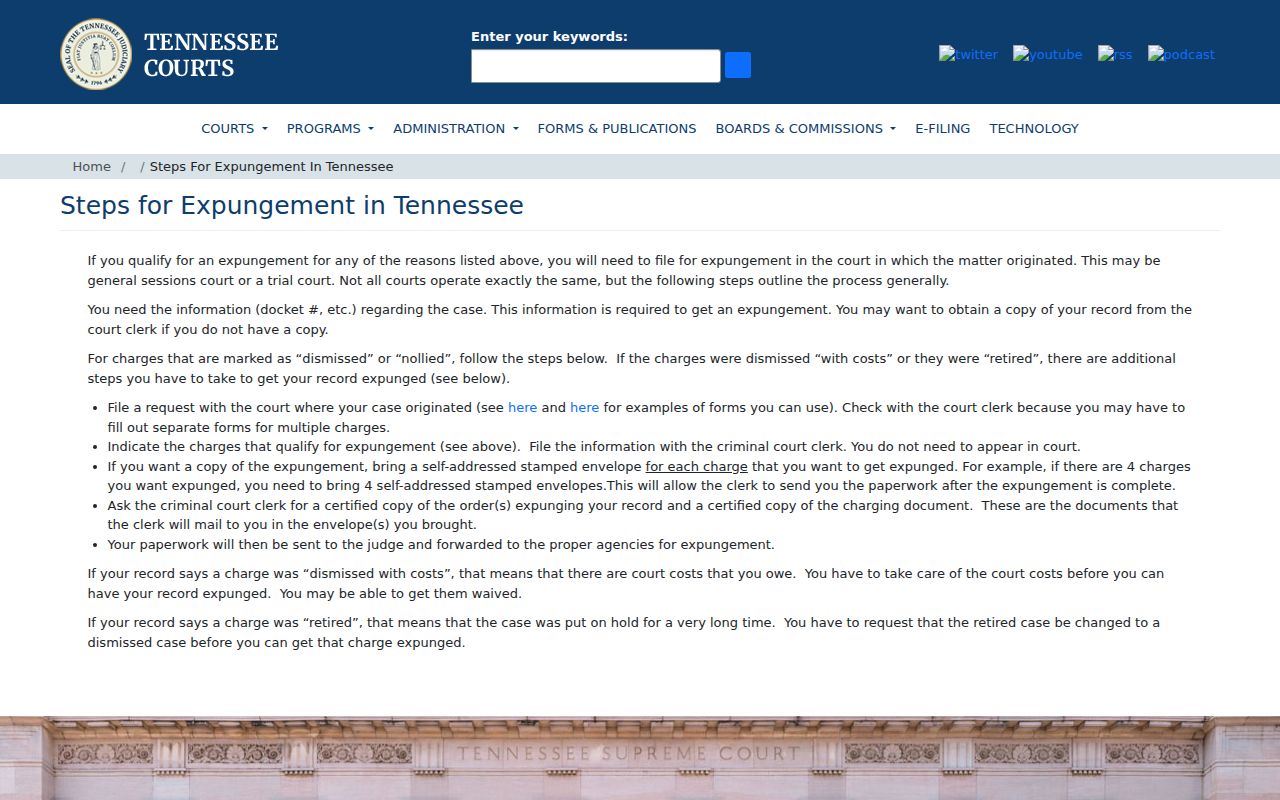
The image connects the public docket to the formal court order required before an eligible Davidson County record is cleared from public systems.